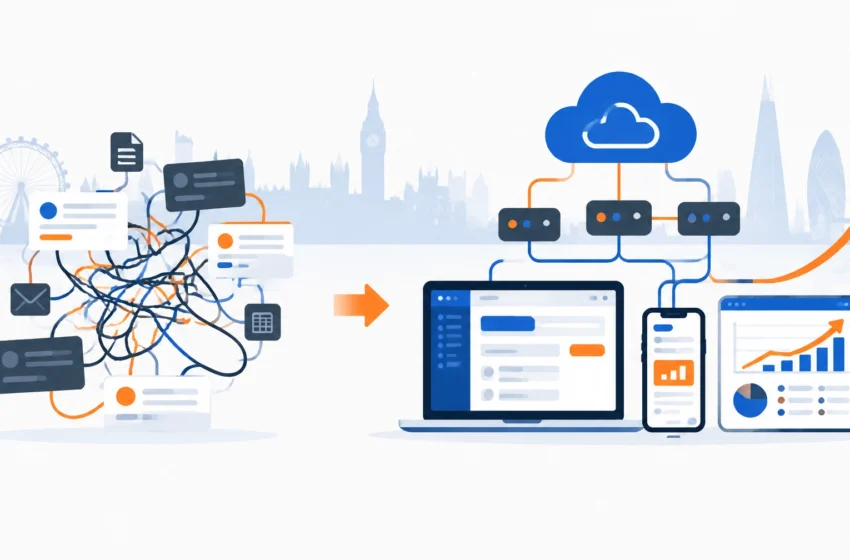
Growth creates pressure. More customers generate more data. More employees create more handoffs. New markets bring new requirements. If your technology cannot keep up, everyday work becomes slower, less visible and more expensive.
The hidden cost is not limited to subscriptions or development budgets. You also pay through duplicated admin, missed opportunities, delayed decisions, poor customer experiences and frustrated teams.
The right digital investment removes those ceilings. Bespoke software development UK businesses use to support real growth gives you technology that fits your goals, workflows and future plans.
The cost of waiting becomes harder to see
When your systems no longer match your business, the warning signs often appear in ordinary tasks:
- Your team enters the same information into several systems.
- Managers wait for manual reports before making decisions.
- Customers contact you because they cannot find updates online.
- Staff rely on spreadsheets, inboxes or workarounds to complete core tasks.
- A new product, location or market requires a separate process.
- Your existing software contains features you do not use but lacks the tools you need.
- Small changes require expensive customisations or long delays.
Each issue seems manageable on its own. Together, they create a growth bottleneck.
You may add another tool to solve one problem. Then another tool creates a new data gap. Eventually, your teams spend more time moving information between systems than acting on it.
That is the real cost of delaying the right technology: your business grows around the constraint instead of moving beyond it.

UK businesses are investing in digital capability
Technology investment remains a central part of business competitiveness. The Office for National Statistics reported that UK business investment increased by 4.3% across 2025, although it fell by 2.5% in the final quarter.
The UK Innovation Survey 2025 found that 34% of UK businesses were innovation active between 2022 and 2024. Computer software remained one of the most common innovation investments.
The direction is clear. Businesses are investing in better ways to operate, serve customers and make decisions. The question is not whether technology matters. The question is whether your investment solves the right business problem.
Why off-the-shelf tools reach their limit
Off-the-shelf software gives you a fast starting point. It works well when your needs match the product’s intended use.
However, your business is not a template.
Generic tools often force you to change your process to fit the software. You then add plug-ins, manual workarounds and separate spreadsheets to cover the gaps. The initial purchase looks efficient, but the total cost grows as your needs become more complex.
A bespoke solution works differently. We design it around your users, processes and outcomes. That gives you:
- A better fit: Your software reflects how your business actually works.
- Connected information: Your teams access consistent data across departments.
- Fewer manual tasks: Automation removes repetitive steps and reduces errors.
- Better user experiences: Customers and employees complete important actions more easily.
- Greater control: You decide which features matter and how the system evolves.
- Stronger scalability: Your platform supports more users, data, features and markets.
Custom does not mean “build everything from scratch”. It means build what creates value, integrate what already works and remove what slows your business down.
Custom software creates room for growth
A growth-ready solution does more than fix today’s inefficiency. It gives you a stronger foundation for tomorrow.
Scale users without adding unnecessary complexity
Your platform should support more customers, employees, partners and suppliers without forcing your team into a new process every time demand increases.
Add features in stages
You do not need every possible feature on day one. A well-planned system lets you release the highest-value functionality first and expand as your priorities develop.
Handle more data
As your business grows, your software needs to manage larger records, more transactions and richer reporting. A scalable architecture keeps performance and visibility on track.
Enter new markets with confidence
New locations, services and customer groups often introduce different rules and workflows. Flexible software lets you adapt without replacing the entire system.
Connect your digital estate
Your custom solution can work with your CRM, finance platform, Microsoft 365 environment, payment tools, databases and other systems. This creates one dependable flow of information instead of isolated data pockets.
What bespoke development looks like in practice
The following examples show how custom technology removes practical growth ceilings.
A football club improves membership and matchday operations
A football club may manage memberships, ticketing, hospitality, merchandise and matchday staffing across separate systems. That makes it difficult to understand each supporter’s journey or coordinate activity on busy matchdays.
A tailored platform can connect membership records, ticket access, communications, payments and staff tasks. Members receive a smoother digital experience. Club staff gain a clearer view of demand. Matchday teams work from current information instead of chasing updates across emails and spreadsheets.
The club gains a platform it can extend with loyalty features, mobile ticketing, community programmes or new commercial services.

A trading company acts on real-time information
A trading business cannot rely on yesterday’s data when market conditions change quickly. Teams need current information, clear alerts and reliable access from different locations.
Custom web app development can bring data sources into one working environment. Role-based dashboards show each person what matters. Automated alerts highlight defined thresholds. A mobile experience keeps key updates available when users are away from their desks.
The result is not simply more data. It is faster access to actionable information and a clearer process for responding to it.
A hospitality business centralises bookings and staff schedules
A hospitality business may coordinate bookings, room availability, customer requests, housekeeping and staff schedules across multiple systems. This creates avoidable delays and makes last-minute changes harder to manage.
A central platform can connect reservations, availability, customer information and workforce planning. Staff see current priorities. Managers identify pressure points earlier. Customers receive more consistent service.
As the business adds locations, the same solution can provide shared visibility while preserving the processes each site needs.

Build the right thing first
The strongest custom projects start with outcomes, not feature lists. Use this practical framework before you commission development.
1. Define the business outcome
Start with the result you want to create.
Do you need to reduce response times? Increase completed bookings? Give managers live visibility? Free up staff from repetitive administration? Improve customer retention?
Write the outcome in measurable terms. “Build a mobile app” is not a business objective. “Give field teams access to live job information and reduce update calls” is.
2. Map the users
List everyone who interacts with the process. Include customers, employees, managers, suppliers and administrators.
What does each user need to do? What information do they need? Where do delays occur? Which tasks create the most frustration?
This step keeps the solution useful for real people rather than impressive only in a specification document.
3. Prioritise the highest-value release
Choose the smallest release that delivers a meaningful result. This may include a customer portal, a workflow dashboard, a booking engine or an automated approval process.
Release value early. Learn from real usage. Then improve the platform with evidence rather than assumptions.
4. Plan for growth from the start
Decide how the system will support more users, locations, data, integrations and features. Plan for accessibility, security, reporting and mobile use from the beginning.
Scalability is not only a technical concern. It protects your investment and gives your team the confidence to expand.
Technical alignment keeps investment focused
Development delivers the best value when it connects directly to your business strategy. That is why technical alignment matters.
Our technology alignment process helps you review your current digital stack, identify roadblocks and focus investment on the capabilities that support growth. You may need a new platform. You may need better integration. You may need to improve an existing system before adding anything else.
The right answer is not always the most expensive technology. It is the technology that solves the right problem at the right stage of your business.
Move from workaround to advantage
Our custom web app development service helps you create intuitive, responsive platforms around your users and workflows. Our software development approach covers discovery, validation, scoping, design, prototyping, development and testing.
When your customers and teams need mobile access, our mobile app development services support iOS, Android and cross-platform experiences. We work with you from ideation through launch and ongoing improvement.
Whether you are looking for bespoke software development UK businesses can rely on, a software development company London decision-makers can work with directly, or a tailored platform for a growing enterprise, the first step is a clear conversation.
What is your current system making harder than it needs to be? We would love to understand where your bottleneck sits and explore a practical, scalable way forward. Talk to Anantek Technologies about your next digital breakthrough.