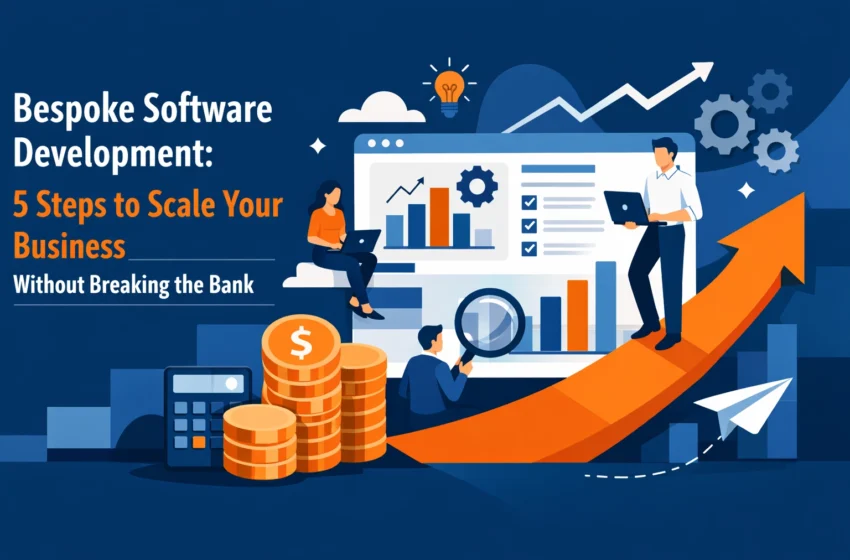
You're ready to scale. Your business is growing, your team is stretched thin, and your current systems are starting to crack under pressure. The solution? Custom software built specifically for your needs. But here's the catch, you're worried about the cost.
Here's what most business owners don't realize: bespoke software development can actually reduce your costs by over 50% compared to cobbling together off-the-shelf solutions that never quite fit. The secret isn't just building custom, it's building smart.
Let's walk through the five essential steps that'll help you scale your business with bespoke software without emptying your bank account.
Step 1: Plan and Define Clear Objectives
Before a single line of code gets written, you need crystal-clear objectives. This isn't busywork, it's your financial safety net.
Think of it this way: every hour spent planning saves you ten hours (and thousands of pounds) in development rework. When you define your business goals, timelines, and scalability requirements upfront, you create accountability that keeps costs controlled.
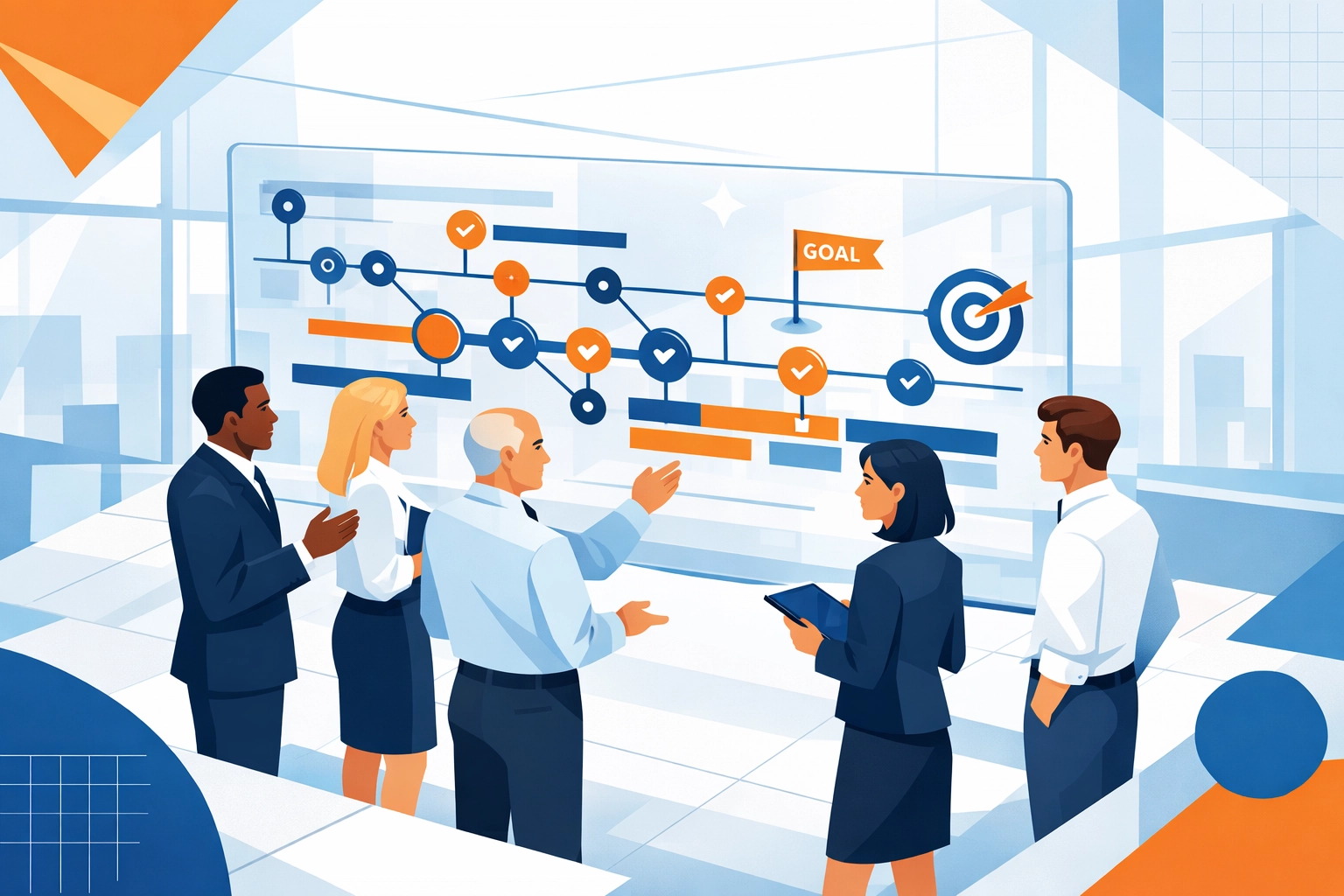
Start by asking yourself these questions:
- What specific business problem are you solving?
- How will success be measured?
- What does your business look like in 12, 24, and 36 months?
- Which processes absolutely must be automated first?
Engage your stakeholders early. Your sales team knows where leads slip through the cracks. Your operations manager knows which manual processes waste the most time. Your finance director knows where hidden costs lurk. Get their input now, because fixing misaligned expectations later costs exponentially more.
This planning phase also establishes your project scope, the boundary between what's essential now and what can wait. A well-defined scope is your best defense against budget creep.
Step 2: Conduct Thorough Discovery and Requirements Gathering
The discovery phase is where smart money gets made. This is arguably the most critical stage for cost management, and it's where many businesses try to cut corners, only to pay dearly later.
A comprehensive discovery translates your business vision into a detailed technical roadmap. You're not just listing features; you're mapping out how your custom solution will integrate with existing systems, handle your specific workflows, and scale as you grow.
During discovery, your development partner should capture:
- Your unique business requirements and constraints
- Current technical infrastructure and limitations
- User scenarios and pain points
- Integration requirements with existing tools
- Long-term growth projections and scalability needs

Here's the real benefit: a thorough discovery phase enables transparent, fixed-pricing structures. You'll know exactly what you're getting and what it costs, no nasty surprises halfway through development. This transparency eliminates the hidden costs that plague many custom development projects.
At Anantek Technologies, we've seen businesses save tens of thousands by investing an extra few weeks in discovery. Why? Because we catch the expensive problems before they become expensive problems.
Step 3: Design with Scalability Built In
This is where you future-proof your investment. Planning for growth during the design phase prevents costly system overhauls down the line.
Off-the-shelf software forces you to scale vertically, buying bigger, more expensive licenses as you grow, often requiring painful platform migrations. Bespoke software scales horizontally with your business. It's designed from day one to handle increased workloads without buckling.
Consider a client who came to us running an e-commerce operation processing 500 orders monthly. They needed a system that could handle 500 orders, but we designed one that could efficiently process 5,000. Eighteen months later, when they hit that growth milestone, their system didn't blink. No emergency upgrades. No frantic calls to developers. Just smooth, uninterrupted growth.
Smart scalability design means:
- Modular architecture that lets you add features without rebuilding
- Database structures optimized for growth
- API integrations that play nicely with future tools
- Performance buffers built into the infrastructure
- Flexible user management that grows with your team
Yes, building in scalability requires upfront investment. But it's a fraction of what you'd spend rebuilding or switching platforms later. Think of it as paying a little now to save a lot later.
Step 4: Develop and Test Systematically
Development isn't a black box: it should be a transparent, collaborative process with clear milestones and progress tracking.
Your development partner should follow the agreed specifications religiously while keeping you in the loop. Regular check-ins, sprint reviews, and demo sessions ensure the solution is evolving in the right direction. These touchpoints cost far less than discovering misalignment at the end.

But here's where quality assurance becomes your secret weapon for cost control. Rigorous testing: manual, automated, and user acceptance: catches bugs before they reach production. Fixing a bug during development costs pounds. Fixing it in production costs thousands, not to mention the damage to your reputation and operations.
A systematic approach includes:
- Regular code reviews to maintain quality standards
- Automated testing that catches regressions early
- User acceptance testing with your actual team members
- Performance testing under realistic load conditions
- Security audits to prevent expensive breaches
This methodical approach minimizes expensive rework. You're building it right the first time, which always costs less than building it twice.
The beauty of custom web app development is that you're not paying for features you'll never use: every function serves your specific business needs. That's efficiency you can't get from generic solutions.
Step 5: Deploy and Provide Ongoing Support
Deployment isn't the finish line: it's the starting gun for your scaled operation.
A structured deployment plan includes training your team, migrating your data safely, and monitoring system performance closely in those critical first weeks. Rush this phase and you'll face user resistance, data issues, and productivity dips that cost real money.
Post-launch support ensures your team adapts smoothly and any teething issues get resolved quickly. This is where service level agreements matter. Clear SLAs define response times, maintenance schedules, and optimization commitments: giving you predictable costs and reliable support.
Here's the long-term advantage: because your bespoke software is built for your business, it can be continuously updated and refined as your needs evolve. No expensive platform switches. No starting from scratch. Just ongoing evolution that keeps pace with your growth.
Ongoing support typically includes:
- Performance monitoring and optimization
- Regular security updates
- Feature enhancements based on user feedback
- Integration with new tools as your tech stack evolves
- Scaling infrastructure as usage increases
This continuous improvement model spreads costs over time while maximizing value. You're not paying enormous license renewals or forced upgrade fees: you're investing in controlled, strategic improvements.
The Real Cost Comparison
Let's talk numbers. Commercial off-the-shelf solutions seem cheaper initially. But factor in:
- Licensing fees that increase as you grow
- Additional costs for integrations and customizations
- Workarounds for features that don't quite fit
- Platform switching costs when you outgrow the system
- Training costs for complex, bloated interfaces
Bespoke development has higher upfront costs but dramatically lower total cost of ownership. Over three to five years, custom solutions consistently prove more economical: and infinitely more effective.
Scale Smart, Not Expensive
Scaling your business with bespoke software isn't about spending more: it's about spending strategically. Follow these five steps, and you'll build a system that grows with you, not against you.
The key is choosing a development partner who understands the business side as well as the technical side. Someone who asks about your growth projections before discussing technology stacks. Someone who treats your budget as seriously as you do.
Ready to explore how custom software development can scale your business without breaking the bank? Let's talk about your specific challenges and map out a cost-effective path forward. Your business deserves software that works as hard as you do.