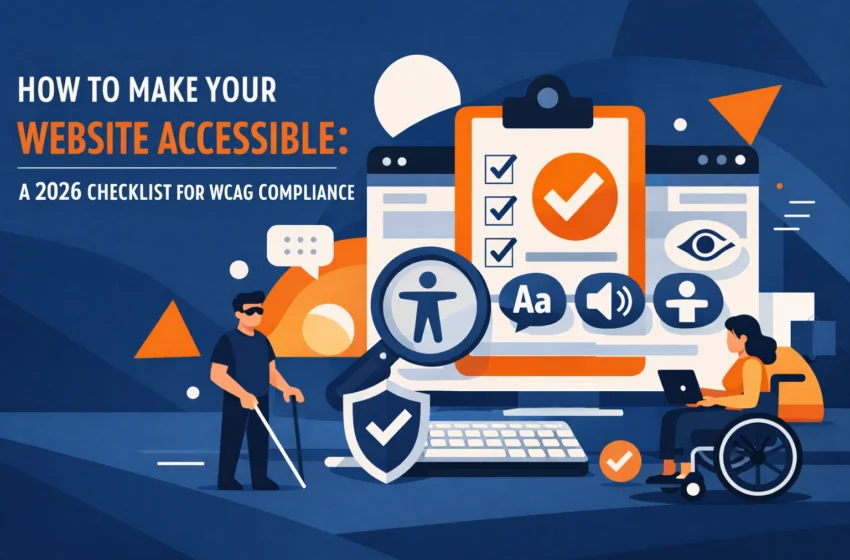
You wouldn't lock the front door of your physical shop to 20% of your customers, would you? Of course not. Yet, many business owners do exactly that online without even realising it.
In 2026, web accessibility isn't just a "nice-to-have" or a gold star from a developer. It is a fundamental requirement for doing business in a digital-first world. Between the tightening of the European Accessibility Act (EAA) and the evolution of WCAG 2.2 standards, ensuring your site is usable for everyone: regardless of their physical or cognitive abilities: is critical.
At Anantek Technologies, we see accessibility as more than just a legal checkbox. It’s about creating an intuitive UI that works for everyone. When you invest in web accessibility compliance services, you aren't just avoiding a lawsuit; you’re opening your doors to a massive, often overlooked market and boosting your SEO at the same time.
Let’s dive into how you can transform your website into a truly inclusive platform.
Why Accessibility Matters More Than Ever in 2026
If you’ve been following the tech landscape, you know that search engines now prioritise user experience (UX) above almost everything else. Google’s algorithms are smarter than ever, and they can tell when a site is frustrating for users. Elements that make a site accessible: like clear navigation, fast loading times, and descriptive alt text: are the same elements that help you climb the search rankings.
Beyond SEO, there's the legal side. Regulatory bodies are no longer looking the other way. Business owners across the UK and Europe are now required to meet specific standards to ensure their digital services are reachable by all.
But let's talk about the best reason: Profit. People with disabilities have immense spending power. If your custom web app or e-commerce site is a nightmare to navigate with a screen reader, those customers will simply take their business to a competitor who cared enough to make their site accessible.
Understanding the POUR Framework
To get accessibility right, you need to understand the four pillars of the Web Content Accessibility Guidelines (WCAG), known as the POUR framework. This is the foundation we use at Anantek when we build bespoke software and web applications.
- Perceivable: Users must be able to perceive the information being presented. It shouldn't be invisible to all of their senses. This means providing text alternatives for images and captions for videos.
- Operable: Users must be able to operate the interface. The site shouldn't require interactions that a user cannot perform (like a mouse-only menu that a keyboard-only user can’t open).
- Understandable: Users must be able to understand the information and the operation of the user interface. Your navigation should be consistent, and your forms should be easy to follow.
- Robust: Content must be robust enough that it can be interpreted reliably by a wide variety of user agents, including assistive technologies like screen readers.
Your 2026 Web Accessibility Checklist
Ready to see where your site stands? Use this checklist to evaluate your current digital presence. If you find yourself ticking "No" more often than "Yes," it might be time to look into professional web accessibility compliance services.
1. Visuals and Contrast
- Text Contrast: Is your text easy to read against the background? In 2026, the standard is a contrast ratio of at least 4.5:1 for normal text.
- Alt Text: Does every meaningful image on your site have descriptive alt text? (Avoid "image1.jpg": go for "A person using a laptop with a high-contrast screen").
- Non-Color Cues: Do you use more than just colour to convey information? For example, are your error messages red and accompanied by an icon or text?
- Text Resizing: Can users zoom in up to 200% without the website breaking or text overlapping?
2. Navigation and Interactivity
- Keyboard Accessibility: Can a user navigate your entire site using only the "Tab" key?
- Focus States: When tabbing through your site, is it visually obvious which element is currently selected? (This is often called a "focus ring").
- Skip Links: Do you have a "Skip to Content" link at the top of your pages to help screen reader users bypass repetitive navigation menus?
- Intuitive UI: Are your buttons and links large enough to be clicked by someone with motor impairments?
3. Multimedia and Content
- Video Captions: Do all your videos have accurate, synchronised captions?
- Audio Transcripts: Is there a text version available for all audio-only content like podcasts?
- No Auto-Play: Does your site avoid playing videos or audio automatically? (This can be incredibly disorienting for screen reader users).
- Clear Headings: Do you use a logical heading structure (H1, H2, H3) rather than just making text bold to show importance?
4. Forms and Data Entry
- Labels: Does every form field have a clear, permanent label?
- Error Identification: If a user makes a mistake on a form, is the error clearly explained and easy to find?
- Time Limits: If your site has a timeout (like for a checkout), can users easily request more time?

Moving Beyond the Basics: Intuitive Accessible Design
At Anantek Technologies, we believe that accessibility shouldn't be an afterthought: it should be baked into the design and development process from day one.
When we talk about "Intuitive UI," we mean a design that feels natural. For a user with a visual impairment, an intuitive UI means the screen reader follows a logical flow. For a user with a cognitive disability, it means the layout is predictable and doesn't overwhelm them with flashing lights or chaotic pop-ups.
We focus on technology alignment. This means we don't just fix the code; we ensure your website's goals align with the needs of every human being who visits it. Whether we are building custom web apps or streamlining your internal software and workflows, accessibility is part of our DNA.
The Risks of Ignoring Compliance
We’ve seen it happen. A business spends thousands on a beautiful new website, only to receive a legal notice six months later because their site doesn't meet WCAG 2.1 or 2.2 standards.
The European Accessibility Act (EAA) has brought a new level of scrutiny. If you offer services in the EU or UK market, you are likely subject to these rules. Fines are one thing, but the damage to your brand reputation can be even harder to fix.
Moreover, an inaccessible site is a leaky bucket. You are spending money on marketing to drive traffic to a site where a significant portion of visitors literally cannot buy what you are selling. That’s not just a compliance issue; it’s a business failure.

How Anantek Technologies Can Help
Transforming a legacy website into an accessible powerhouse can feel like a daunting task. Where do you start? Do you rebuild or patch?
This is where our expertise comes in. Our team specializes in web accessibility compliance services that take the headache out of the process. We don't just give you a list of errors; we provide solutions.
- Accessibility Audits: We perform deep-dive audits using both automated tools and manual human testing (because AI still can't tell you if a site "feels" right).
- Bespoke Remediation: We update your code and design to meet WCAG standards without sacrificing your brand’s aesthetic.
- Accessible Custom Development: If we’re building your project from scratch, accessibility is included from the first line of code.
- Ongoing Support: Accessibility isn't a "one and done" job. Every time you add a new blog post or product, you need to ensure it stays compliant.
Adapt Your Business for the Future
The internet is for everyone. As we move further into 2026, the gap between businesses that embrace accessibility and those that ignore it will only widen. By making your website accessible today, you are future-proofing your business, reaching more customers, and standing out as a leader in your industry.
Don't let technical hurdles hold you back. Let's work together to make your digital presence inclusive, intuitive, and high-performing.
Ready to unlock the full potential of your website? Contact us at Anantek Technologies today and let’s discuss how our web accessibility compliance services can drive your business forward. We’d love to help you build something that everyone can use.