Stop settling for "off-the-shelf" software that forces you to change how you work. If you’re a business owner, you know that efficiency is the lifeblood of your bottom line. Yet, many companies spend thousands on generic subscriptions that only solve 60% of their problems, leaving the other 40% to be handled by messy spreadsheets and manual data entry.
Custom web application development isn't just a technical upgrade; it’s a strategic investment. When planned correctly, a bespoke application acts as a force multiplier for your team, automating drudgery and unlocking new revenue streams.
However, jumping into development without a roadmap is a recipe for disaster. Research shows that nearly 70% of project failures stem from poor requirements and planning. You wouldn't build a house without a blueprint, and you shouldn't build software without a plan.
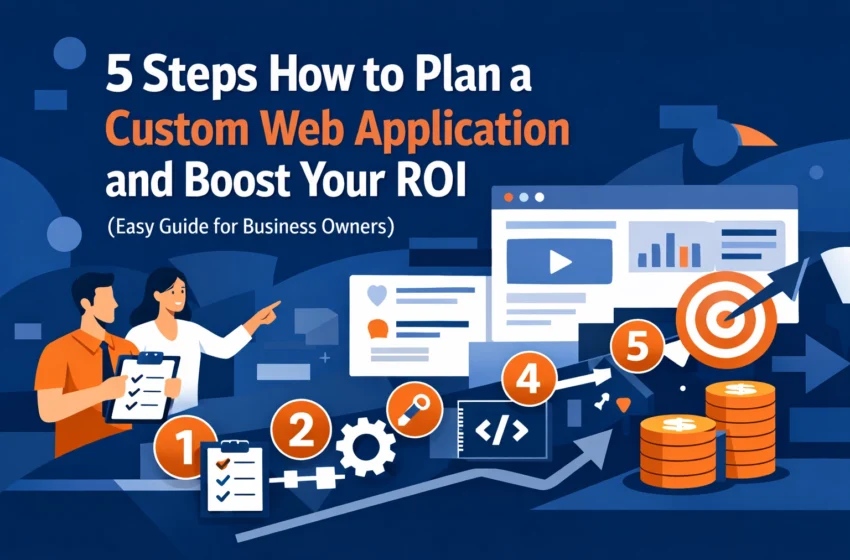
Here are the five essential steps to plan your custom web application and ensure you maximize your Return on Investment (ROI).
1. Define Your Vision and Set Crystal Clear Goals
Every successful piece of software starts with a "Why." Before you write a single line of code or talk to a developer, you need to identify the specific business problem you are trying to solve.
Are you looking to automate manual processes to save on labor costs? Do you want to reach a new customer base through a specialized portal? Or are you aiming to consolidate data from five different sources into one dashboard?
Identify your Key Performance Indicators (KPIs):
- Time Savings: How many hours per week will this save your staff?
- Conversion Rates: Will a better user experience increase your sales?
- Error Reduction: How much is human error in data entry costing you right now?
By defining these early, you prevent "scope creep": the phenomenon where a project grows uncontrollably and eats your budget. When you have a clear goal, every feature is measured against its ability to move the needle on your ROI.

2. Audit Your Current Systems and Select the Right Tech
You don’t always need to tear everything down to build something great. A crucial part of the planning phase is evaluating your existing infrastructure. At Anantek, we call this the Technology Alignment Process. We look at what you’re currently using: whether it's an old legacy CRM or a series of Microsoft 365 tools: and determine how a new application can complement them.
The Tech Stack Choice:
Selecting the right technology is about longevity and scalability. You want a framework that is modern enough to be powerful but stable enough to be supported for years.
- Backend: We often look at frameworks like Express.js or Python-based Django for their speed and security.
- Frontend: Tools like React or Vue.js ensure your application is fast and responsive across all devices.
Choosing the right technology upfront prevents "Technical Debt": the hidden cost of having to rewrite your software two years down the line because the original tools were outdated or poorly chosen.
3. Prioritize Features and Build an MVP (Minimum Viable Product)
One of the biggest mistakes business owners make is trying to build the "perfect" version of their software on day one. Large, overly complex projects have a success rate of only about 6%. In contrast, small, focused projects succeed 58% of the time.
The secret to a high ROI is the MVP approach.
Identify the core features that solve your primary problem and build those first. If you are building a custom web application, focus on the "must-haves" that allow you to launch and start seeing value immediately.
Why the MVP wins:
- Faster Launch: You get to market (or into your staff’s hands) in weeks, not months.
- Real-World Feedback: You learn how users actually interact with the app before spending money on "nice-to-have" features they might never use.
- Revenue Generation: You start seeing an ROI almost immediately, which can then fund the next phase of development.
4. Design for the User, Not the Developer
User Experience (UX) is not just about pretty colors; it is a direct driver of profit. Statistics show that a well-designed User Interface (UI) can raise conversion rates by up to 200%, and superior UX can boost them by a staggering 400%.
If your employees find a tool difficult to use, they will find ways to bypass it. If your customers find your portal confusing, they will leave.
During the planning phase, insist on seeing wireframes and mockups. These are visual blueprints of the application. They allow you to "walk through" the software before it is built. It is infinitely cheaper to move a button on a design file than it is to rewrite code once development has started.
Focus on creating a seamless workflow that reduces friction. The less time a user spends thinking about how to use the app, the more time they spend being productive within it.
5. Plan for Seamless Integration and Scaling
In the modern business environment, no application is an island. Your custom web app needs to talk to your existing tools. Whether it’s your accounting software, your CRM, or your data analytics platform, seamless integration is key to long-term growth.
The Integration Advantage:
- Automation: Automatically push sales data from your app into your CRM.
- Single Source of Truth: Ensure that customer data is consistent across every department.
- Future-Proofing: Ensure your app has an API (Application Programming Interface) so that future tools can easily connect to it.
Nearly 98% of enterprises report difficulty integrating disparate systems. By planning your integrations at the start, you bypass this headache and create a unified digital ecosystem that scales as your business grows.
Why Custom is the Smart Choice for Your ROI
When you buy off-the-shelf software, you are paying for hundreds of features you will never use, while still lacking the three or four features you actually need.
Custom software is built specifically for your workflows. It grows with you. If you need to add a mobile app component later, a custom-built web app provides the perfect foundation to do so without starting from scratch.
How Anantek Technologies Drives Your Success
At Anantek, we don't just write code; we align technology with your business goals. We understand that as a Managing Director or business owner, you care about outcomes: efficiency, growth, and profitability.
Our approach to bespoke software development is built on partnership. we work with you to navigate these five steps, ensuring that the final product doesn't just work: it excels.
Ready to transform your business operations?
We’d love to talk to you about your vision. Whether you have a fully-fleshed-out idea or just a problem that needs solving, we can help you map out a path to a high-ROI solution.
Contact us today to start your technology alignment journey and stay ahead of the competition.
Key Takeaways for Business Owners:
- Start with Goals: Don't build for the sake of building. Solve a specific problem.
- The MVP is Your Friend: Launch early, gather data, and refine.
- UX is Revenue: Good design pays for itself through higher adoption and conversion.
- Integrate Early: Ensure your new tools play well with your old ones to unlock full automation potential.
- Think Long-Term: Custom software is an asset that appreciates in value as you tailor it to your evolving business needs.