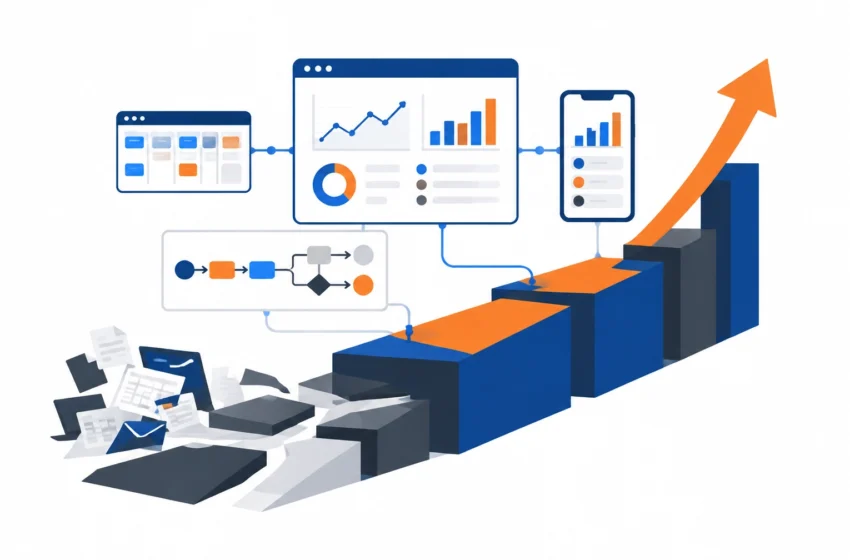
Growth feels exciting until the systems that worked for 10 people start slowing everyone down.
A shared spreadsheet becomes a reporting system. Email becomes a workflow tool. A founder becomes the approval point for every decision. Teams copy data between a CRM, finance platform, Microsoft 365, and several disconnected tools.
You can still win customers. You can still grow revenue. But every new customer, employee, location, or service adds more pressure.
The answer is not to buy more software at random. You need a practical path from manual, fragmented operations to a scalable digital platform. That path combines bespoke software development, custom web app development, mobile capability where it adds real value, and disciplined technology alignment.
Why growth breaks the systems that worked before
Small teams often rely on knowledge, flexibility, and personal communication. That works when everyone sits close together and understands the whole business.
Growth changes the operating model.
More people create more handoffs. More customers create more data. More locations create more variation. More services create more decisions. The informal systems that once created speed now create inconsistency.
Consider three familiar examples:
- A growing hospitality business: At 10 employees, the manager handles bookings, staff rotas, supplier updates, and customer issues through a spreadsheet and messaging apps. At 35 employees across two sites, the same approach creates duplicated bookings, missed shift updates, and hours of weekly administration.
- A football club: A small team manages memberships, ticket queries, merchandise, sponsors, and community activity through separate inboxes and spreadsheets. As membership grows, staff cannot quickly see a supporter’s history or identify which requests still need action.
- A growing consultancy: Ten consultants track leads in a CRM, project delivery in spreadsheets, and expenses in email threads. At 30 consultants, directors spend valuable time reconciling project status, utilisation, and billing information instead of developing the business.
The cost appears in practical ways:
- Staff repeat the same data entry.
- Managers wait for reports.
- Customers receive slower responses.
- Errors create rework and refunds.
- Leaders become a bottleneck.
- Teams make decisions using different versions of the truth.
The goal is not to remove every human decision. The goal is to give your people one reliable way to manage work, access information, and move customers forward.
Turn your process into the product
Bespoke software development works best when it reflects how your business creates value.
You do not start with a long feature list. You start with the process that matters most. What needs to happen from enquiry to delivery? Where does work wait? Which information does each person need? What does “complete” mean?
At Anantek Technologies, we use a phased roadmap that keeps investment focused.
1. Discovery: understand how work really happens
Start by mapping one important workflow from beginning to end.
This could be:
- Booking to service delivery
- Membership application to renewal
- Lead to signed project
- Request to resolution
- Order to invoice
We identify the people involved, the systems they use, the decisions they make, and the information they exchange. We also identify workarounds. These often reveal the real process more clearly than an existing procedure document.
The output is a clear view of your current workflow and the best opportunity for improvement.
2. Focused first release: solve one valuable problem
Your first release should create a visible business result.
That may mean one shared dashboard, one guided workflow, one customer portal, or one automated approval process. It does not need to contain every feature your business will ever need.
A focused release helps you:
- Test the process with real users
- Prove value sooner
- Reduce delivery risk
- Capture practical feedback
- Create a foundation for future features
This approach gives you progress without committing your business to a large, inflexible project.
3. Iterate: improve with evidence
Once people use the first release, you can see what works and what needs to change.
You can measure cycle times, incomplete requests, customer response times, and points where staff still leave the system to complete work elsewhere.
Then you improve the workflow. You simplify screens. You add useful notifications. You refine permissions. You connect another system when the business case is clear.
4. Scale: extend the platform with control
When the first workflow is stable, you can extend the same approach to other areas.
Add further teams, locations, customer journeys, reporting views, and integrations. Keep the underlying structure consistent so your platform grows without creating another collection of disconnected tools.

Build one operating layer with a custom web app
A custom web app gives your business one operating layer across the work that matters.
It can bring together:
- Customer and account data
- Orders, bookings, projects, or cases
- Tasks and approvals
- Dashboards and performance measures
- Role-based access
- Documents and communication history
- Automated alerts and handoffs
- Connections to your existing systems
Instead of asking people to remember where information lives, the app guides them through the right process.
A customer service colleague sees open requests. A manager sees workload and service performance. A finance user sees what is ready for invoicing. A director sees the metrics linked to growth.
Role-based access ensures people see the information and actions relevant to their responsibilities. That supports security without making the experience unnecessarily complicated.
Your web app can also connect with your CRM, ERP, finance tools, databases, and Microsoft 365 environment. The purpose is not to replace every platform. It is to stop your team from copying information between them.
Our custom web app development service focuses on tailored, responsive solutions that work across desktop, tablet, and mobile devices. We combine intuitive design with testing, security, and ongoing improvement.
The result is a practical system your team can use every day, not another tool that creates more administration.
Add mobile when it creates a better experience
Mobile app development services create value when people need to act away from a desk or when customers need quick, convenient access.
Mobile is a strong fit for three common situations.
Customer self-service
Give customers a simple way to book, update details, view status, make payments, submit requests, or receive notifications.
You reduce avoidable contact while giving customers greater control.
Field teams
Help mobile workers capture information at the source. They can update job status, record notes, upload photographs, collect signatures, or receive their next task without returning to the office.
That reduces delays and removes the need to re-enter handwritten information later.
Member engagement
Clubs, associations, and organisations can use mobile to share updates, manage memberships, provide event information, and create a more direct relationship with members.
The key question is simple: does mobile make the action faster, easier, or more immediate?
If the answer is no, a responsive web app may provide the better experience.
Your web and mobile applications should share one backend. That means both channels use the same customer records, workflow rules, permissions, and reporting data. Your team avoids maintaining separate versions of the truth.
Explore Anantek’s mobile app development services for tailored Android, iOS, and cross-platform solutions delivered from ideation through launch and ongoing support.

Keep spend focused with technical alignment
Technology alignment prevents development investment from becoming disconnected from business priorities.
Use a simple four-part framework.
People
Who performs the work? Who owns the outcome? Who approves exceptions? What does each role need to see and do?
Your answers shape user journeys, permissions, training, and accountability.
Process
What is the simplest reliable way to complete the work? Which steps protect quality? Which steps only exist because an old system or habit requires them?
Digitising a confusing process simply makes confusion faster. Improve the process before you automate it.
Data
Where does each important piece of information live? Who updates it? Which system is the source of truth? How do you measure data quality?
Clear data ownership prevents duplicate records and unreliable reporting.
Platforms
Which existing tools should stay? Which need better integration? Where does custom software create a clear advantage? How will Microsoft 365, CRM, ERP, finance, and analytics work together?
You do not always need the most expensive technology. You need the right technology for your goals, people, and stage of growth.
Our technology alignment process helps you assess your current digital stack, identify gaps, and build a roadmap that supports future growth. We can also help you optimise your Microsoft 365 environment so your team gets more value from the tools you already use.
Calculate the cost of waiting
Before you delay a digital improvement, calculate what the current process costs.
Use this prompt:
How many people repeat the task each week × hours spent per person × hourly cost × 52 weeks?
For example:
- 3 coordinators
- 6 hours each per week
- £28 estimated hourly cost
- 52 weeks
That equals £26,208 per year in one repeated administrative activity.
This calculation excludes delayed invoices, missed opportunities, customer frustration, reporting delays, and management time. It also excludes the cost of scaling the same inefficient process to twice the volume.
Run this checklist during the current month:
- List your five most repeated manual tasks.
- Record how many people perform each task.
- Estimate weekly hours and internal cost.
- Identify where data gets copied between systems.
- Find the workflow that creates the most customer delay.
- Choose one process with a clear owner and measurable outcome.
- Define three success measures, such as time saved, fewer errors, or faster response.
- Review your technology alignment across people, process, data, and platforms.
- Decide whether the first release needs a web app, mobile capability, integration, or workflow automation.
- Set a date for a discovery session.
Build the next stage with a clear plan
You do not need to transform every part of your business at once.
Start with one process that limits capacity or affects customer experience. Map it. Improve it. Build a focused first release. Measure the result. Then extend the platform with confidence.
That is how bespoke software development supports growth without creating another layer of chaos.
Anantek Technologies works with businesses from startups to established enterprises. We combine custom web app development, mobile app development services, software development, automation, data analytics, Microsoft 365 optimisation, and technology alignment in one collaborative partnership.
If you are looking for a bespoke software development UK partner or a software development company London businesses can rely on for long-term support, we’d love to talk to you. We will help you turn your most important process into a scalable digital platform that drives your business forward.