The right software choice gives you more than new features. It gives you back time, improves customer experiences, and creates a stronger foundation for growth.
But should you choose an off-the-shelf SaaS platform or invest in custom web app development?
The honest answer is simple: it depends on how your business works today, where it is going next, and how much control you need along the way.
Off-the-shelf software offers speed and convenience. Custom software offers flexibility and ownership. Both options can support growth. The best choice depends on the value your software creates over time.
This guide gives you a clear framework for making that decision.
Off-the-shelf software gives you speed
Off-the-shelf SaaS is ready to use. You choose a plan, create user accounts, configure a few settings, and start working.
That speed makes SaaS the right choice for many businesses.
Choose off-the-shelf software when:
- Your processes follow common industry patterns.
- You need a solution within days or weeks.
- Your team is small and your requirements are straightforward.
- The software supports a non-core activity, such as email marketing or basic accounting.
- Your budget does not support a large upfront project.
- You do not need deep integrations or specialised workflows.
For example, a startup may choose a standard CRM to manage its first customer relationships. A small consultancy may use a project management platform to organise delivery. A growing team may use Microsoft 365 for communication, collaboration, and document management.
Why build something custom when a proven tool already solves the problem?
That is the right question. You should not build custom software simply because you can.
However, SaaS stops being simple when your team grows, your processes become more specialised, and your business depends on workarounds.
Custom web app development gives you control
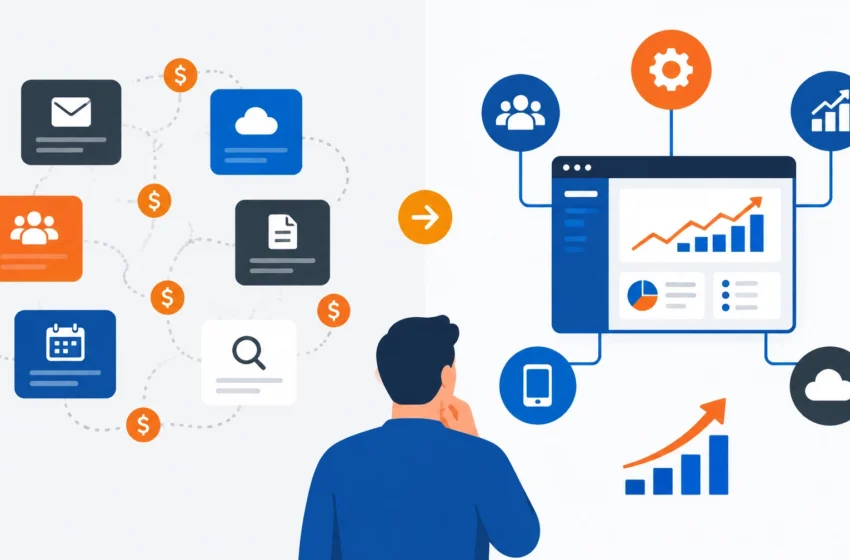
Custom web app development creates a digital product around your business rather than asking your business to adapt to someone else’s system.
That difference affects everything from daily productivity to long-term costs.
With a tailored application, you can:
- Create workflows that match the way your team actually works.
- Connect data across systems without relying on manual exports.
- Give each user the right information and permissions.
- Automate repetitive tasks at the point where they happen.
- Build dashboards around the decisions your team makes.
- Scale features as your business expands.
- Design accessible, responsive experiences for every user.
Our custom web app development service starts with your goals, users, and processes. We use discovery, prototyping, design, development, and testing to create a solution that supports your next stage of growth.
The goal is not to add complexity. The goal is to remove it.

Compare the real cost, not the starting price
The biggest mistake businesses make is comparing a SaaS subscription with the initial cost of bespoke software development UK businesses often commission.
That comparison misses the full picture.
Off-the-shelf SaaS costs include:
- Monthly or annual licences.
- Additional user seats.
- Premium features and support tiers.
- Paid integrations.
- Marketplace apps.
- Price increases.
- Staff time spent on manual workarounds.
- Admin time spent maintaining disconnected systems.
- Migration costs when the platform no longer fits.
A £50 monthly subscription looks affordable. Ten separate tools, rising licence fees, paid integrations, and several hours of manual administration tell a different story.
This is subscription creep. It happens when businesses add one tool after another to solve individual problems. Over time, the business pays for overlapping features while staff move information between platforms.
Custom software costs include:
- Discovery and planning.
- User experience and interface design.
- Development and testing.
- Hosting and monitoring.
- Ongoing maintenance.
- Security updates.
- Future enhancements.
Custom software requires a larger upfront investment. You own an asset designed around your processes, though. You also gain more predictable control over future improvements.
For a fair comparison, model both options across three to five years. Include staff time, integration costs, price increases, support, and the cost of eventual migration.
Research comparing custom software and SaaS regularly highlights this total-cost-of-ownership gap. See this custom software versus SaaS cost analysis for further context.
Workarounds reveal the real problem
Workarounds are not always a problem. Every business uses small manual processes from time to time.
The issue starts when workarounds become part of the daily operating model.
You may recognise the pattern:
- A customer submits information through one platform.
- Someone exports it into a spreadsheet.
- Another team updates a second system.
- A manager waits for a report.
- Someone checks the data manually.
- The team repeats the process every day.
How much does that process cost over a year?
The cost includes wages, delays, errors, duplicated work, and missed opportunities. It also prevents your team from focusing on customers and growth.
A custom web app can connect the workflow directly. It can collect the right information once, route it to the right person, update connected systems, and show current data in one place.
That is where custom software starts to pay for itself. It turns repeated administration into a streamlined process.
Integration limits affect your growth
SaaS platforms integrate within the limits of their APIs, connectors, and marketplaces.
If your process fits those limits, integration stays straightforward. If it does not, you may need middleware, custom scripts, manual imports, or an entirely separate tool.
That creates risk.
A platform update can break an automation. A connector may not support the data you need. A new pricing tier may make a critical integration more expensive. Your team may also spend hours checking whether information moved correctly.
A custom solution lets you design integrations around your operations. Our software development service supports integrations with CRMs, ERPs, databases, APIs, and Microsoft 365 environments.
You do not need to replace every platform. Often, the best approach connects the tools you already use with a custom workflow that removes the friction between them.
Data ownership and vendor lock-in matter
With SaaS, a vendor hosts your data and controls the platform. You access the system through its rules, features, pricing, and export options.
That arrangement works well when the vendor remains aligned with your needs.
What happens if the price changes? What happens if a key feature disappears? What happens if you need to move your data to another platform?
Vendor lock-in goes beyond downloading a CSV file. You may need to rebuild custom fields, automations, integrations, permissions, reports, and user processes. The migration also takes time and creates disruption.
With custom software, you can retain greater control over your data model, hosting arrangements, access rules, and future roadmap. You should also protect that control through clear contracts, technical documentation, standard technologies, backups, and access to the source code.
Custom development does not remove every technology risk. It gives you more influence over how you manage that risk.

Accessibility cannot be an afterthought
Off-the-shelf software often includes mature interfaces and established accessibility features. That gives SaaS a strong advantage when you need a usable tool quickly.
Custom software gives you the opportunity to go further, but you need to plan for accessibility from the start.
Your application should support:
- Keyboard navigation.
- Clear visual hierarchy.
- Readable colour contrast.
- Helpful form labels and error messages.
- Responsive layouts across devices.
- Screen reader compatibility.
- Simple, consistent user journeys.
Accessibility supports more than compliance. It helps more people use your systems confidently and reduces confusion for everyone.
Our approach to web and software development includes usability, responsive design, and testing throughout the project. A well-designed solution should feel intuitive rather than demanding extra training.
When mobile app development services add value
A web app may provide everything your internal team needs. In other cases, customers, field workers, members, or sales teams need access while they are away from a desk.
That is where mobile app development services add value.
A mobile application can support:
- Customer self-service.
- On-site data collection.
- Instant notifications.
- Member or supporter engagement.
- Mobile payments.
- Real-time updates.
- Secure access to key workflows.
You do not need to choose between web and mobile at the beginning. A strong custom platform can provide a shared foundation, with mobile experiences added when they create clear business value.
Worked example: a trading company outgrows generic tools
Imagine a growing trading company using a CRM, spreadsheets, email, and a separate reporting platform.
The setup works with ten employees. As the team grows, several issues appear:
- Client information sits across multiple systems.
- Operations staff re-enter order details.
- Managers wait for weekly reports.
- Sales and operations work from different versions of the truth.
- The company pays for more seats and integrations each year.
- The team cannot easily introduce its own approval rules.
The company does not need a custom replacement for every tool. It needs a connected operating layer.
A custom web app can bring together client records, trading workflows, approvals, reporting, and role-based access. It can connect with existing finance or communication tools while giving the business ownership of its core process.
The investment pays for itself through fewer manual updates, faster decisions, clearer accountability, and a platform that supports future growth.

Use this five-point decision scorecard
Score each statement from 1 to 5:
-
Process fit
1 means your process is completely standard.
5 means your process is highly specialised. -
Manual effort
1 means very little manual work.
5 means your team regularly copies, checks, or re-enters data. -
Integration pressure
1 means your current tools connect easily.
5 means your team relies on workarounds or spreadsheets. -
Strategic importance
1 means the software supports a secondary activity.
5 means it directly affects your customer experience or competitive advantage. -
Growth pressure
1 means your current system supports your plans.
5 means your system already limits growth.
Read your score
- 5–10: Off-the-shelf SaaS probably remains the right choice. Review subscriptions regularly and avoid unnecessary add-ons.
- 11–17: Consider a hybrid approach. Keep proven SaaS tools and build custom workflows around your most important processes.
- 18–25: Custom web app development deserves a serious business case. Calculate the five-year cost and define a phased roadmap.
The score does not make the decision for you. It shows where to investigate.
Avoid expensive software mistakes
Before committing to either option:
- Map your current workflow before choosing a platform.
- Calculate total cost over at least three years.
- Count staff time spent on manual administration.
- Separate essential requirements from preferences.
- Check data export and migration terms.
- Confirm integration limits before signing a contract.
- Test accessibility with real users.
- Start with a focused minimum viable product.
- Build a roadmap for future enhancements.
- Choose a partner that explains trade-offs clearly.
The right software development company in London should help you decide whether custom development is justified. We start with the business case, not a predetermined technology package.
Make the choice that supports your next stage
Off-the-shelf software is the right call when speed, simplicity, and predictable standard workflows matter most.
Custom web app development is the stronger choice when your process drives value, workarounds consume time, integrations limit progress, and long-term control matters.
You do not need to choose based on hype. Compare the full cost, the daily experience, and the growth opportunity.
At Anantek Technologies, we work with startups and enterprises to turn complex processes into scalable, user-friendly digital solutions. We would love to talk through your current setup, your growth plans, and the point at which custom software starts to create real value for your business.
Explore our services or contact our team to start the conversation.